https://hiedler.at/en/product/herbst/
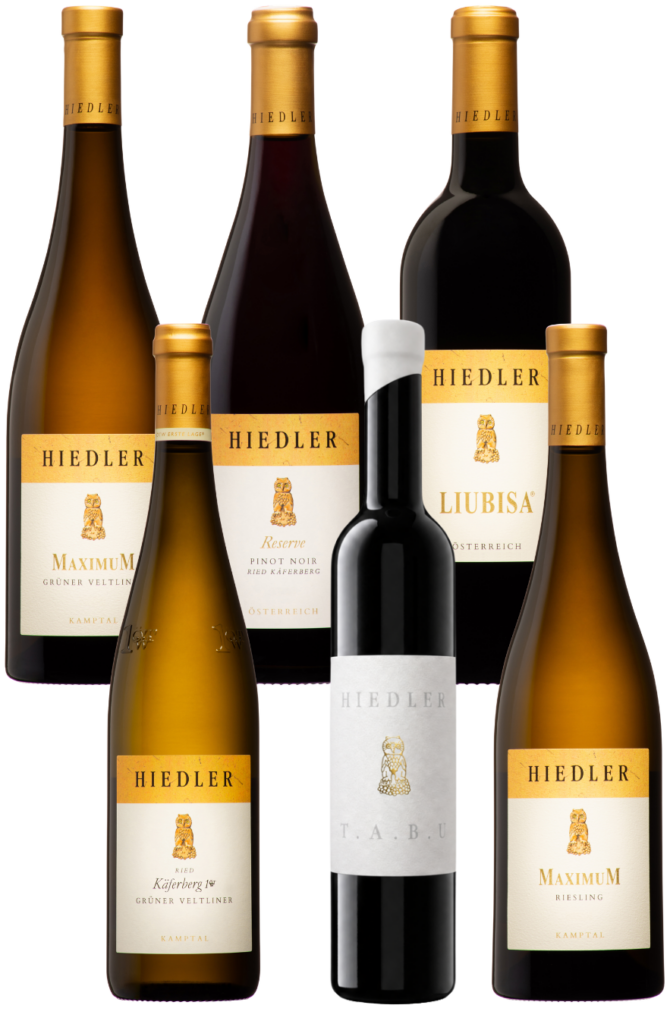
Goldener Herbst
Sechs Weine für den Herbst. Nicht, weil der Herbst Wein braucht. Sondern weil Wein den Herbst besser macht. Eine Auswahl aus Langenlois, die zwischen Herkunft, Reife, Spannung und Trinkfreude pendelt. Für lange Abende, für Pilze, Wild und Schmorgerichte. Oder einfach für den Moment, in dem draußen das Licht früher ausgeht und drinnen noch eine Flasche aufgehen darf.
Im Paket:
1 x Grüner Veltliner Maximum Alte Reben 2023
1 x Grüner Veltliner Ried Käferberg 1ÖTW 2023
1 x Riesling Maximum Alte Reben 2023
1 x Pinot Noir Reserve Ried Käferberg 2023
1 x Liubisa 2023
1 x T.A.B.U (0.375 lt., süß)
If you are interested to buy this wine, please contact us or our trading partners: Where to buy.


About this package
→ MAXIMUM ALTE REBEN Grüner Veltliner
It takes decades for the vines to grow into a mighty, gnarled stature and for their roots to reach the deepest layers of the loess and crystalline rock soils. Our Maximum is sourced from a carefully selected collection of these very old vines that are growing in the historic terraced vineyards of Langenlois. Their yields are extremely low, resulting in exceptionally concentrated grapes. The valuable fruits are harvested, when they have fully ripened to a golden hue. Before bottling, the wine matures on the lees for at least two full winters in traditional acacia barrels. The result is a dense, mouth-filling Veltliner, pushing the limits of concentration and grape variety to the Maximum.
→ RIED KÄFERBERG 1ÖTW Grüner Veltliner
Its unique geology and altitude make the Käferberg in Langenlois one of the outstanding vineyards in the Kamptal region. In a small area, you can find old crystalline rock fragments intermingled with marine sediments (clay marl) and rare gravels deposited in the Paratethys Sea millions of years ago and have remained directly on the bedrock of the Bohemian Massif. Our vines grow at an altitude of approximately 340 meters, on two terraces on the southeast slope of the vineyard, where some chalky loess has also accumulated over the past millennia. The small grapes from the old vines planted in the 1940s achieve exceptional concentration on this soil. The additional salty-mineral freshness creates a distinctive and exciting contrast.
[1.ÖTW = Classified Vineyard, Erste Lage (Premier Cru)] [Ried = Austrian Term for single vineyard, same meaning as “Lage”]
→ MAXIMUM ALTE REBEN Riesling
It takes decades for the vines to grow into a mighty, gnarled stature and for their roots to have penetrated the deepest cracks and crevices of the crystalline rock soils. Our Maximum is sourced from a carefully selected collection of these ancient vines that are growing in the historic terraced vineyards of Langenlois. Their yields are extremely low, resulting in exceptionally concentrated grapes. The valuable fruits are harvested, when they have fully ripened to a golden hue. Before bottling, the wine matures for at least two full winters on the lees. This gives rise to a dense and brimming-with-juice Riesling, pushing the limits of concentration and grape variety to the Maximum.
→ RESERVE RIED KÄFERBERG Pinot Noir
The grapes for this Reserve thrive on a terrace on the southeast flank of the Käferberg in Langenlois, one of the outstanding vineyards in the Kamptal, at an altitude of about 325 meters above sea level. In a small area here, old crystalline rock fragments alternate with young clay marl, chalky loess, and rare pebbles that were deposited in the Paratethys Sea millions of years ago. The vineyard was planted with a particularly high plant density. The intense competition for water and nutrients forces the roots to penetrate even deeper into the soil, resulting in small and wonderfully concentrated grapes. The result is characterized by elegance and calmly flowing fruit, complemented by the typical salty freshness of the Käferberg.
→ LIUBISA
In 1986, after completing his apprenticeship in Italy, a young winemaker from Langenlois dared to secretly smuggle S*****vese cuttings entrusted to him by his mentor across the border into Austria and planted them in secret. At that time, cultivating this grape variety in the Kamptal was not permitted (and still isn't today). The resourceful winemaker quickly found a clever solution for his experiment, blending what is likely the northernmost S*****vese in Europe with a portion of his Pinot Noir. This is how the cuvée LIUBISA was born. "Liubisa," meaning "lovely valley," is the original name of Langenlois, given by the first settlers from the north-east to describe this idyllic region.
[Austrian Regulations prohibit us from specifying the vintage and grape variety on the label. Please get in touch with us for more information.]
→ T.A.B.U.
A unique whim of nature gave us this extraordinary wine: freezing cold meets healthy, fully ripe grapes. The sudden onset of winter in the Kamptal offered us the historical chance to harvest what may well be the world's first S*****vese Ice Wine, and certainly the first in Austria. As the frozen berries were pressed, highly concentrated must dripped slowly from the press over many hours. During a slow fermentation, it developed into a unique, noble sweet wine with intense fruit, fine sweetness, and a vibrant acidity that provides great tension. A truly rare wine that won't come around again anytime soon.
It takes decades for the vines to grow into a mighty, gnarled stature and for their roots to reach the deepest layers of the loess and crystalline rock soils. Our Maximum is sourced from a carefully selected collection of these very old vines that are growing in the historic terraced vineyards of Langenlois. Their yields are extremely low, resulting in exceptionally concentrated grapes. The valuable fruits are harvested, when they have fully ripened to a golden hue. Before bottling, the wine matures on the lees for at least two full winters in traditional acacia barrels. The result is a dense, mouth-filling Veltliner, pushing the limits of concentration and grape variety to the Maximum.
→ RIED KÄFERBERG 1ÖTW Grüner Veltliner
Its unique geology and altitude make the Käferberg in Langenlois one of the outstanding vineyards in the Kamptal region. In a small area, you can find old crystalline rock fragments intermingled with marine sediments (clay marl) and rare gravels deposited in the Paratethys Sea millions of years ago and have remained directly on the bedrock of the Bohemian Massif. Our vines grow at an altitude of approximately 340 meters, on two terraces on the southeast slope of the vineyard, where some chalky loess has also accumulated over the past millennia. The small grapes from the old vines planted in the 1940s achieve exceptional concentration on this soil. The additional salty-mineral freshness creates a distinctive and exciting contrast.
[1.ÖTW = Classified Vineyard, Erste Lage (Premier Cru)] [Ried = Austrian Term for single vineyard, same meaning as “Lage”]
→ MAXIMUM ALTE REBEN Riesling
It takes decades for the vines to grow into a mighty, gnarled stature and for their roots to have penetrated the deepest cracks and crevices of the crystalline rock soils. Our Maximum is sourced from a carefully selected collection of these ancient vines that are growing in the historic terraced vineyards of Langenlois. Their yields are extremely low, resulting in exceptionally concentrated grapes. The valuable fruits are harvested, when they have fully ripened to a golden hue. Before bottling, the wine matures for at least two full winters on the lees. This gives rise to a dense and brimming-with-juice Riesling, pushing the limits of concentration and grape variety to the Maximum.
→ RESERVE RIED KÄFERBERG Pinot Noir
The grapes for this Reserve thrive on a terrace on the southeast flank of the Käferberg in Langenlois, one of the outstanding vineyards in the Kamptal, at an altitude of about 325 meters above sea level. In a small area here, old crystalline rock fragments alternate with young clay marl, chalky loess, and rare pebbles that were deposited in the Paratethys Sea millions of years ago. The vineyard was planted with a particularly high plant density. The intense competition for water and nutrients forces the roots to penetrate even deeper into the soil, resulting in small and wonderfully concentrated grapes. The result is characterized by elegance and calmly flowing fruit, complemented by the typical salty freshness of the Käferberg.
→ LIUBISA
In 1986, after completing his apprenticeship in Italy, a young winemaker from Langenlois dared to secretly smuggle S*****vese cuttings entrusted to him by his mentor across the border into Austria and planted them in secret. At that time, cultivating this grape variety in the Kamptal was not permitted (and still isn't today). The resourceful winemaker quickly found a clever solution for his experiment, blending what is likely the northernmost S*****vese in Europe with a portion of his Pinot Noir. This is how the cuvée LIUBISA was born. "Liubisa," meaning "lovely valley," is the original name of Langenlois, given by the first settlers from the north-east to describe this idyllic region.
[Austrian Regulations prohibit us from specifying the vintage and grape variety on the label. Please get in touch with us for more information.]
→ T.A.B.U.
A unique whim of nature gave us this extraordinary wine: freezing cold meets healthy, fully ripe grapes. The sudden onset of winter in the Kamptal offered us the historical chance to harvest what may well be the world's first S*****vese Ice Wine, and certainly the first in Austria. As the frozen berries were pressed, highly concentrated must dripped slowly from the press over many hours. During a slow fermentation, it developed into a unique, noble sweet wine with intense fruit, fine sweetness, and a vibrant acidity that provides great tension. A truly rare wine that won't come around again anytime soon.